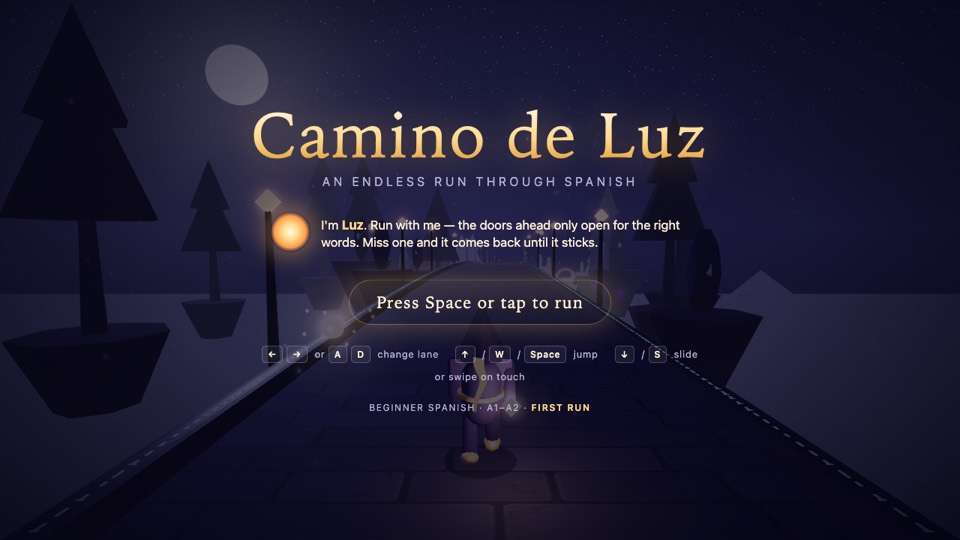
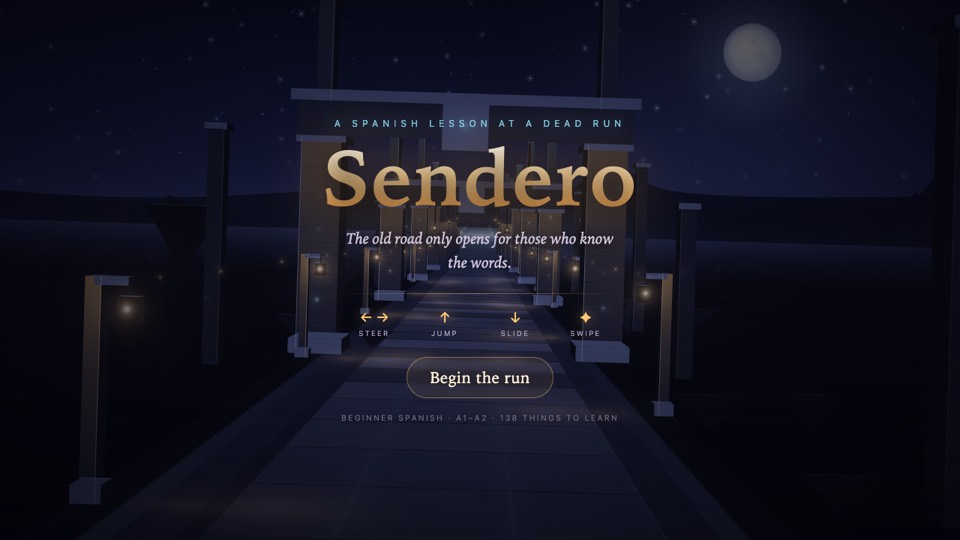
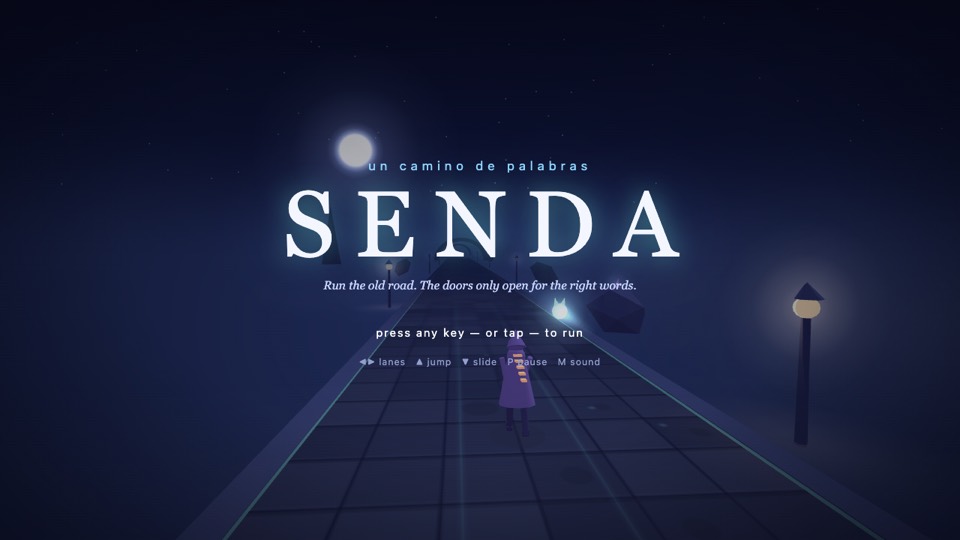
read the brief all three received
# One-shot brief: an endless runner where you run on the right answers

You are working fully autonomously in this empty directory. Nobody will answer
questions, so do not ask any. Make every decision yourself and keep going until
the game is genuinely finished. This is your only message.

## What to build

A browser endless runner in the spirit of Subway Surfers, where the way forward
is unlocked by knowing things. The player runs, jumps and slides through a
beautiful, magical, mysterious world, and every few seconds the path splits
into doors or is blocked by an obstacle that only the right answer opens. It is
a real language lesson disguised as a great run, with a tutor character at the
player's side.

## What it teaches

Spanish for an English speaker, beginner level (A1 to A2). Build the content
in: at least 80 items across vocabulary (everyday words with an example
sentence), simple grammar (present-tense verb forms, gender and articles,
common prepositions) and short phrases. Everything must be correct Spanish; do
not invent words or forms. Missed items come back sooner and more often, the
way spaced repetition works, so a ten-minute run genuinely teaches. The run
summary shows what the player learned and what they still get wrong.

## Required, in priority order

1. **A run that feels great.** Three lanes, continuous forward motion that
   speeds up, jump and slide, near-misses that feel dangerous, a camera with a
   little lag, a sense of speed. Keyboard (arrows or WASD) and touch swipes both
   work, controls shown on screen. Hitting an obstacle costs a life; losing all
   lives ends the run with a summary and an instant restart.
2. **Learning as the core mechanic, not a popup.** Two kinds of learning moment,
   both read while running, never pausing the game:
   - **Door gates.** The prompt appears ahead (for example: `the book`, or
     `yo ___ (comer)`), then the path splits into three doors, each carrying an
     answer. The correct door opens; a wrong door stumbles the player, and the
     tutor explains the mistake in one line while the run continues.
   - **Sealed obstacles.** A barrier ahead carries a prompt; the player breaks
     through by steering into the lane whose rune shows the right answer, or
     takes the hit.
   Give the player enough time to read at the current speed; difficulty grows
   through both speed and content.
3. **The tutor.** A named companion character with a warm, brief voice, shown
   as text on screen and present in the world. Reacts to streaks, mistakes,
   and new words; never lectures; one or two short lines at a time.
4. **A world worth running through.** Beautiful, magical, mysterious: think
   mist, lanterns, glowing runes, ancient stone, deep colour, moonlight. Not
   cartoon-bright. The world changes as the run goes on (zones, time of day,
   weather or light shifts) and never shows an edge. Hold 60 fps on a normal
   laptop and run on a phone.
5. **Score and feel.** Score, streak multiplier for consecutive correct
   answers, lives, distance. A title screen, a pause state, an end-of-run
   summary with the words learned and missed. Small touches that make it feel
   alive: particles, screen shake on impact, a glow when a door opens.
6. **Sound** generated in code with the Web Audio API: a running rhythm that
   rises with speed, a chime for a correct door, a dull thud for a wrong one, a
   soft ambient bed for the world. No external audio files.

## Hard constraints

- Deliverable is one self-contained `index.html` in this directory. It must run
  by opening the file directly in a browser. Scripts from a public CDN are
  allowed; no build step, no bundler, no server, no framework scaffolding.
- No external assets of any kind: no images, models, fonts or sounds fetched
  from anywhere. Everything is generated in code.
- The browser console must be clean when the game runs.

## How to work

- Plan first, then build in increments, then polish. Respect the priority
  order: a gorgeous run with door gates that teach thirty words well beats a
  feature list that stutters or teaches wrong Spanish.
- Verify your own work. Open the file in a headless browser if one is available
  (install what you need locally with npm), check for console errors, take
  screenshots, look at them, fix what is wrong, and iterate on visual quality
  until it is something people would want to share.
- When you consider it finished, write `NOTES.md`: what you built, how the
  learning works, what you deliberately left out, known bugs, and what you
  would add with one more hour. Be honest; the notes are read together with
  the game.

This game and your notes will be shown side by side with other attempts at this
same brief to a large audience. Make it worth their time.